An underpinning of Nursing Excellence is an environment and culture where nurses are empowered, supported, and feel valued. This culture of empowerment should lead to better patient quality outcomes, increased Patient Satisfaction results, and improved nurse engagement. But does it?
The answer is resoundingly yes, it does.
HealthLinx analyzed our robust database of results, specifically for the past six years for RN Engagement, Nurses Sensitive Indicators, and Patient Satisfaction, and the results show a significant improvement in all three areas.
RN Engagement
HealthLinx all database RN Engagement data (from 2018-2024) was reviewed using all available vendors and all categories including:
- Adequacy of Resources & Staffing,
- Autonomy,
- Fundamentals of Quality of Nursing Care,
- Interprofessional Relationships,
- Leadership Access & Responsiveness,
- Professional Development, and
- RN-RN Teamwork & Collaboration.
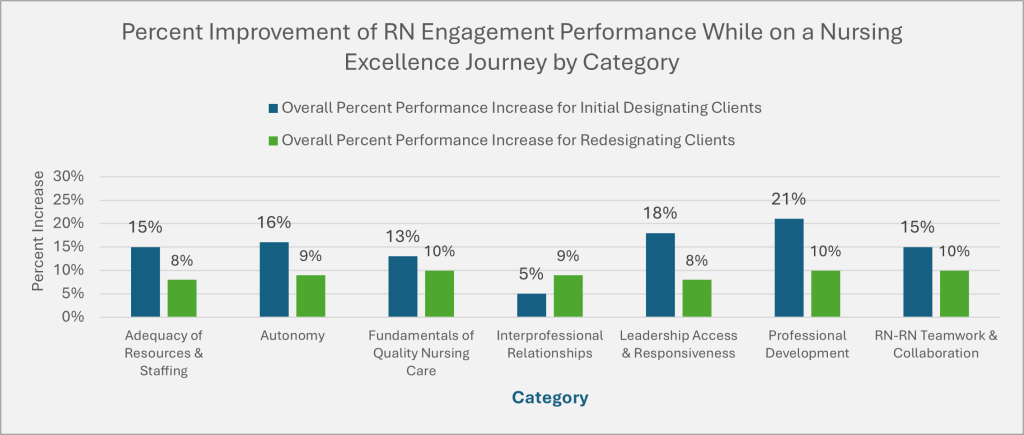
All seven categories showed improved results from the first survey taken at the start of the Nursing Excellence Journey with HealthLinx to the last survey submitted as part of the Nursing Excellence documentation. Professional Development showed the largest improvement with an overall 14% increase and Interprofessional Development showed the least improvement with an overall 8% increase.

The data was also analyzed by separating initial designating and redesignating facilities’ results. All RN Engagement categories had increases in performance with both groups. Interestingly, Interprofessional Relationships was the only category that showed more significant improvement in redesignating facilities than in initial designating facilities. An inference can be made that improvements in Interprofessional Relationships require some foundational elements to be in place to serve in support.
For example, we often see extensive work in initially designating facilities around leadership interaction, RN to RN interaction, autonomy, and professional development. The supposition is those structures and processes are a helpful precursor to other types of work such as improving interprofessional collaboration and dynamics, and therefore, the improvement in those results were not reflected until examined at time of a Nursing Excellence Journey redesignation.
Nurse Sensitive Indicators
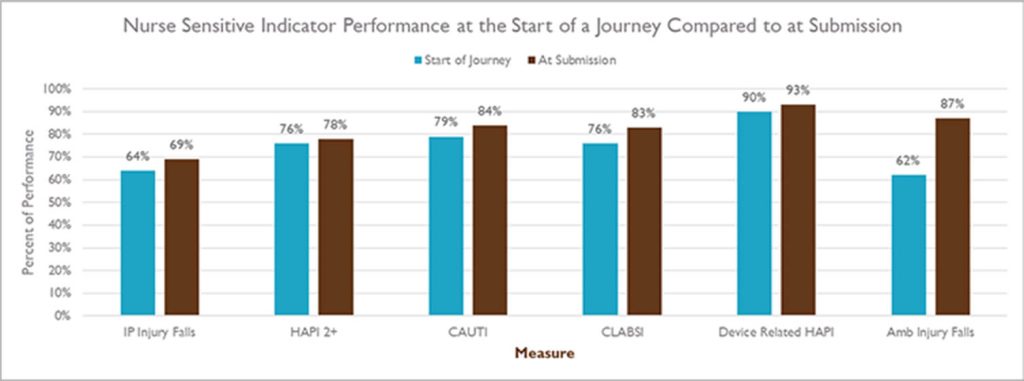
Nurse Sensitive Indicator data was reviewed looking at a facility’s overall performance by indicator at the beginning of their Nursing Excellence journey compared to their overall performance at their Nursing Excellence document submission. Every measure showed improvement. This improvement translates into a reduction in the number of patient events that can be very costly to an organization.
Patient Satisfaction
Patient Satisfaction data was reviewed using all available vendors and all categories analyzing a facility’s overall performance by category at the beginning of their Nursing Excellence journey compared to their overall performance at their Nursing Excellence document submission. Inpatient and Ambulatory settings showed improvement with their overall scores in every category.


Summary
The HealthLinx performance results for RN Engagement, Nurse Sensitive Indicators, and Patient Satisfaction strongly indicate that organizations embarking on a Nursing Excellence Journey will have better patient quality outcomes, increased Patient Satisfaction results, and improved nurse engagement. Furthermore, those organizations who complete a redesignation Nursing Excellence Journey realized improvements in Interprofessional Relationships.