Strategies to reinvigorate and enhance the Nurse leadership roles are front and center as Nurse Executives develop and execute their nursing strategic plans.
Leadership development is currently a topic of extensive discussion and innovation within healthcare organizations. A core tenet of discussion and action seeks to solve; how do we best engage, develop, empower, support, advance and leverage our nurse leaders’ clinical and operational expertise, as well as their ability to enable leaders to build and maintain effective teams to achieve strategic goals?
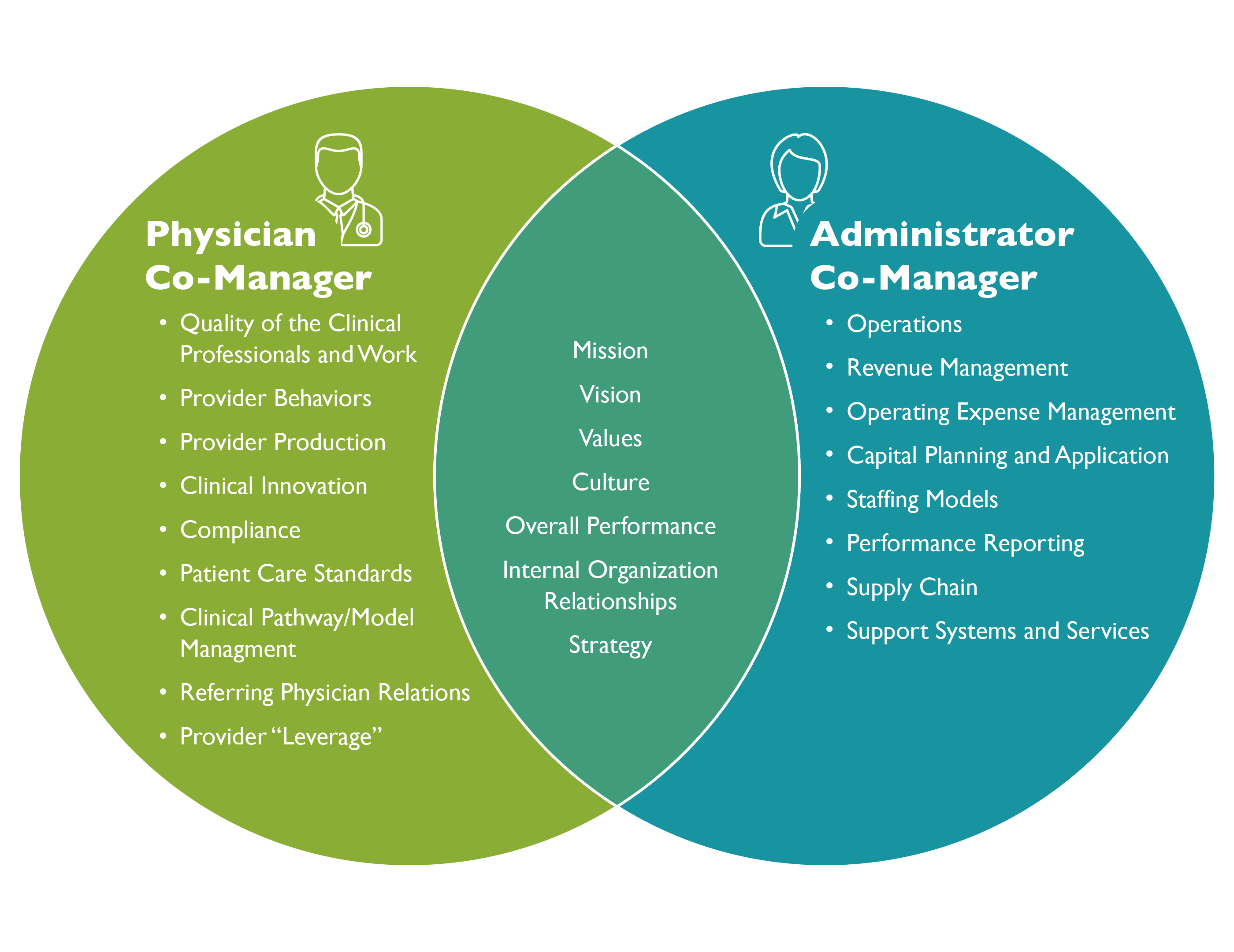
Inherent in the strategic goals is elevating nursing practice, executing initiatives to achieve nursing strategic goals and objectives and best support the path to organizational excellence.
It is with deliberate intention that I, as a nurse leader, have chosen to present and explore key aspects of the dyad leadership model to highlight a leadership model that is inclusive of both nursing/administrative leaders and physician leaders.
It is a model that supports the integration of the two largest workforces in healthcare and incorporates diverse expertise, skills, and leadership roles/responsibilities with expectations of equal accountability for achieving organizational excellence. As you observe the dyad model, you are witnessing the transformative value and synergy when two leaders become one, partnered under a strategic mission and vision that is balanced in ensuring high performing care delivery and organizational sustainability.

The dyad leadership model is not new in healthcare; it has become the standard for driving interprofessional and multidisciplinary collaboration to execute on initiatives targeted at achieving strategic performance goals within organizations and systems in both acute care and ambulatory services.
In fact, as the model has become more prevalent, inclusive, and scaled within organizations and systems, it is evolving further from collaboration to that of partnership.
In healthcare, the dyad leadership model consists of a clinical member, usually a physician, and an administrative member who co-lead their areas of responsibility.
With focused planning, the dyad leadership model can be scaled at any level of an organization. In its simplicity, it is a model in which a physician assumes responsibility for creating a clinical vision and a nurse/administrative leader operationalizes the vision.
The dyad model can be applied at the manager, director, and senior/ executive leadership levels, as well as at the system level.
Nurse/administrative leaders co-managing with physician medical directors, advanced practice providers and/or physician champions is one example of how the dyad model can be applied at various levels within a community hospital and dyadically scaled accordingly in academic and quaternary medical centers.
This partnership sets strategic direction within the organization and oversees management of day-to-day operations. The model’s effectiveness is rooted in combining the nurse/administrative leader and physician leader expertise, unique skills, leadership attributes and perspectives to improve clinical, quality, operational and business outcomes.
Advantages/benefits of dyad leadership include:
- Fosters team-based care, inclusivity and interprofessional collaboration to improve care coordination, care delivery, quality outcomes, patient experience, sustainability and hardwire change – fosters a culture of organizational excellence – capable of continuous growth and change.
- Fosters improved nurse/physician/provider relationships through mutual respect, trust, integrity, and recognition of the value of each member.
- Integration of clinical expertise with decision-making processes
- Better, more inclusive, and balanced decision-making surrounding strategic planning and execution.
- Establishes clear leadership roles, responsibilities, expectations, and accountability.
- Fosters more streamlined communication, enhanced transparency between nurses and physicians, as well as across multidisciplinary teams and key stakeholders.

- Facilitates patient-centered care.
- Facilitates a holistic approach to care.
- Fosters a proactive versus reactive approach to leadership planning and decision-making.
- Fosters leadership continuity and enhanced professional development which may reduce leader burnout (by building a solid partnership and team dynamic) – reduced dependence on individual leaders.
- Amplifying the value of each member through empowerment rooted in continuous learning, through diverse skill and knowledge exchange – fuels successful leadership succession planning and ensures smooth transitions when leadership changes happen.
With the advantages and benefits noted above, dyad leadership is not without its challenges and potential barriers.
Challenges and potential barriers to successful dyad leadership efficacy and effectiveness include:
- Lack of incumbent leader(s) comfort in transitioning away from established hierarchal single individual leadership model – seen as diminishing or devaluing individual leader expertise, experience and clinical and leadership growth associated with intentional career advancement – physicians value autonomy while operational leaders’ value interdependence.
- Resistance to change (unit, department or service line and organizational levels)
- Communication and relationship barriers rooted in misaligned leadership and communication styles/approaches, conflict resolution and lack of trust in mutual alignment of strategic vision, goals and objectives – it is important to note that it takes time to build trust – historically physicians and operational leaders have distinct core values which can hinder collaboration and trust, especially in the absence of clarity around equity
- Role ambiguity resulting from lack of clear, defined role, responsibilities, and expectations.
- Inequity/imbalance regarding shared decision making and authority.
- Lack of clear performance and accountability metrics
- Inadequate or misaligned structure to vertically and horizontally integrate departments/services to support and optimally execute dyad leadership strategic initiatives to achieve strategic performance improvement goals.
Key requisite attributes to optimize the efficiency and effectiveness of the dyad partnership include:
- Ability to lead with integrity and mutual respect.
- Ability to articulate vision and inspiring others to engage in the vision – a leader your team will want to follow in both good and bad times.
- Demonstrate a high level of leadership interprofessional collaboration, engagement, commitment, and accountability.
- Demonstrate effective communication skills with bi-directional communication.
- Engaging and leading with transparency and inclusiveness
- Display a high level of empathy, humility, emotional intelligence, introspection, professional maturity – foster resilience and joy in daily work.
- Ability to celebrate and recognize performance wins and deep dive analysis of performance shortfalls focused on process versus people.
- Ability to leverage clinical and operational/business expertise to execute team-led strategic initiatives focused on improving performance – clinical quality & outcomes, patient care delivery, patient experience, operational and financial.
- Ability to make and execute tough/controversial decisions and lead through leadership transitions and culture change.
- Ability to effectively lead and manage conflict resolution.
- Ability to promote and engage in leadership development to facilitate succession planning.
Identifying, developing, and retaining leaders who can not only perform, but thrive is critical in achieving a high performing, effective dyad.
Leadership is hard even in periods of stability with positive trends in patient outcomes, patient experience, and operational and financial performance and downright daunting during periods of instability and crisis. Leaders with the requisite skills and expertise to effectively lead in a dyad role during such times are rare; high performing leaders are grown, developed, and curated over time and are carefully and diligently recruited into the dyad leadership role.
High-performing organizations are diligent in identifying and developing internal employees, intentional in external recruitment and instituting a systematic process for preparing subsequent leaders.
As organizations and systems continue to focus and prioritize on leadership alignment to improve and sustain strategic performance goals within nursing, as well as organizational excellence, strategic utilization of an effective, high-performing dyad leadership model is a powerful, fuel-efficient engine to definitively drive the journey. Hence, careful consideration of the best nursing/administrative and physician leaders to place into the dyad role is critical in achieving leadership alignment and optimizing performance results.
Nurse and senior executives should carefully assess existing leaders to ensure their success and effectiveness, as well as exercise caution in placing leaders into the dyad roles who lack the requisite leadership skills, expertise, and experience to ensure effective dyad performance.
Placing leader(s) to fill a gap in the short term may result in ongoing, chronic underperformance, increased organization risk, leader burn out and loss of promising leaders who need further development only.
Careful consideration of temporary, short-term, external, high-performing transformational/transitional leadership support to mentor/apprentice the incumbent leader(s) and allow for intentional recruitment of the ideal permanent candidate(s) to sustain performance and mitigate risk should be evaluated with due diligence.