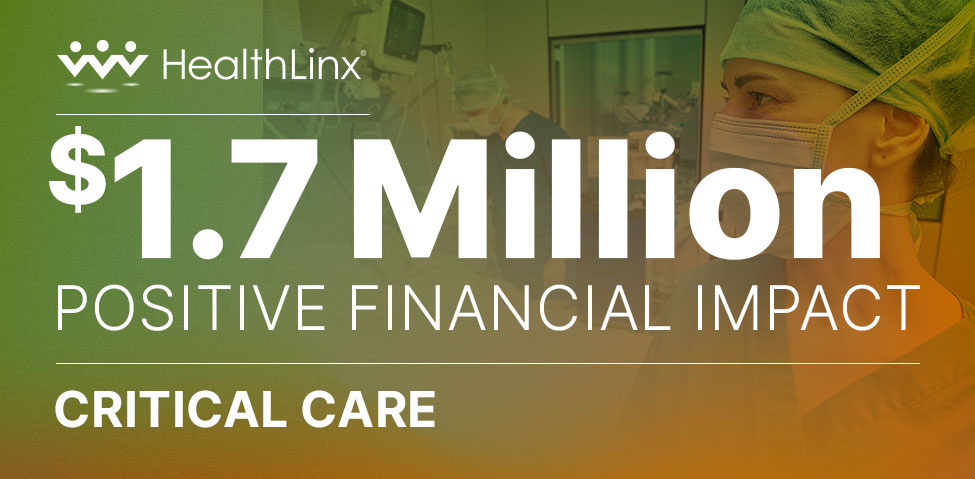
Healthcare leaders are constantly challenged to improve patient outcomes while maintaining financial stability. One of the most valuable lessons from a recent rural hospital transformation is that success often starts with asking the right question.
In this feature, we will review the following question a HealthLinx Transitional CNO asked to gain impactful improvements in a rural hospital.
Are we fully capturing the patients and services we already have?
Many hospitals focus on growing market share, adding providers, or building new programs. While those strategies have value, there is often significant opportunity hiding within existing operations.
In this case, a transitional CNO discovered opportunities in three key areas:
- Inpatient admissions that were not fully captured.
- Patients whose status may not have been optimized for appropriate reimbursement.
- An underutilized swing bed program that had capacity for growth.
Rather than chasing new business, the organization first focused on improving processes already within its control.
How to Address the Problem:
- Evaluate Your Admission Process
- Are patients being admitted under the correct status?
- Are case managers involved early enough in the process?
- Are potential admissions unnecessarily transferred elsewhere?
Sometimes small workflow gaps can lead to significant revenue loss and missed opportunities for patient care.
- Review Your Case Management Structure
Case management plays a critical role in both patient outcomes and financial performance.
- Do case managers have clearly defined responsibilities?
- Is someone focused on high-value programs such as swing beds, rehabilitation, or care transitions?
- Are providers and case managers working closely together?
The stronger the collaboration, the stronger the outcomes.
- Assess Leadership Accountability
A common challenge in healthcare is assuming that systems are the problem when leadership structure may actually be the issue.
- Are leaders visible and engaged with frontline staff?
- Are managers held accountable for measurable outcomes?
- Do leaders have the support and coaching they need to succeed?
Strong leadership often drives improvement faster than any new technology or initiative.
- Expand Staff Capabilities
Many hospitals have untapped capacity simply because staff have not been trained to manage more complex patient populations.
Consider:
- What competencies would allow us to care for more patients locally?
- Are we maximizing the skills of our nursing teams?
- Are staff working at the top of their licenses?
Expanding capabilities can create both better patient access and stronger financial performance.
What Outcomes Can You Expect
When hospitals successfully address these areas, the results can be significant.
Operational
- Increased patient admissions
- Improved patient flow
- Better use of available beds
- Reduced unnecessary transfers
- Stronger collaboration between departments
Leadership
- Greater accountability
- Improved staff engagement
- More effective decision-making
- Increased leadership presence and visibility
Financial
- Improved reimbursement capture
- Growth in post-acute and swing bed revenue
- Better productivity
- Stronger overall financial performance
Patient Care Outcomes
- More patients receiving care closer to home
- Improved continuity of care
- Enhanced patient experience
- Increased access to rehabilitation and recovery services
Leadership Takeaway
The most successful hospitals are not always the ones with the biggest budgets or newest facilities. They are often the organizations willing to honestly examine their operations and ask tough questions.
If your hospital is struggling with growth, staffing challenges, or financial pressure, start by asking:
“Are we fully capturing the opportunities that already exist within our organization?”
The answer to that single question could uncover the next major opportunity for improvement, sustainability, and long-term success.